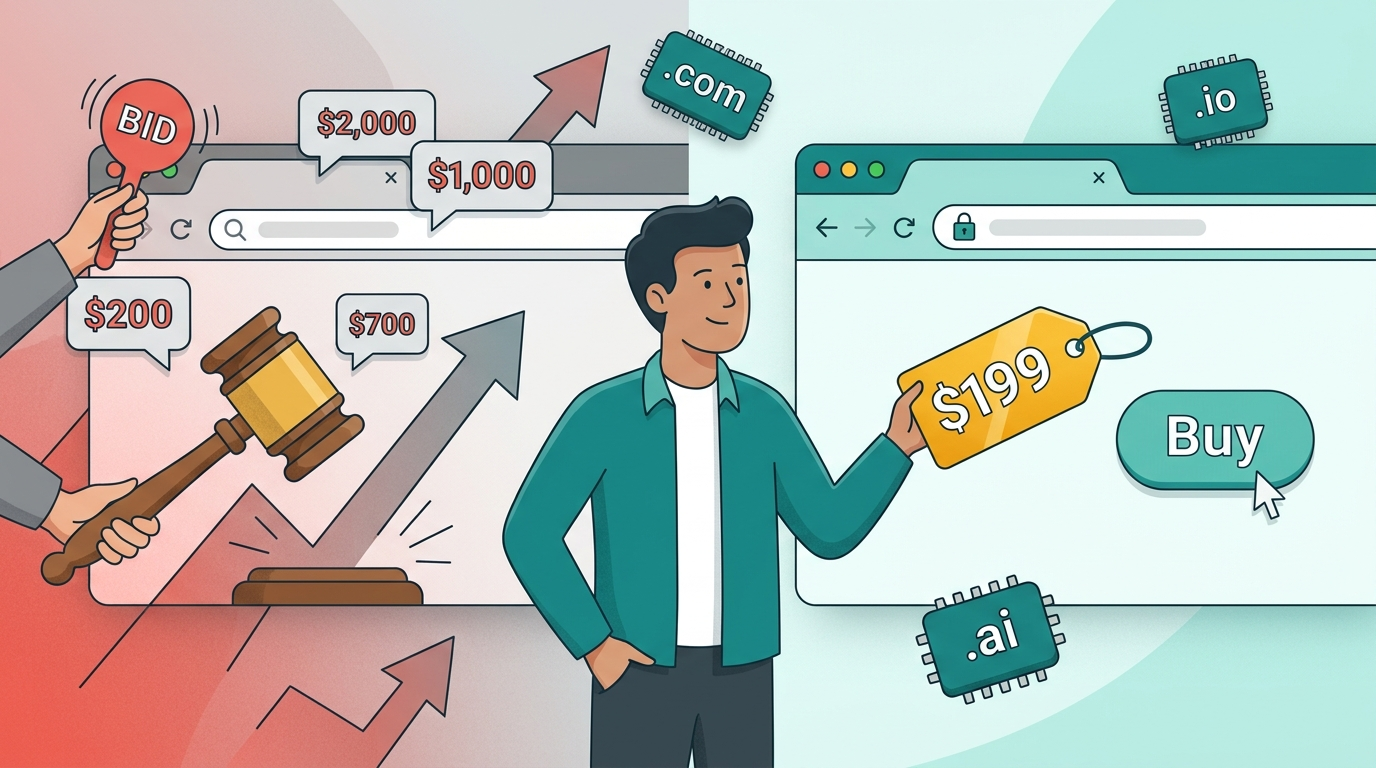
When a domain appears to sell for $800 at auction, did the buyer actually pay $800?
Not usually.
I have been on both sides of hundreds of domain transactions, and the single most common mistake I see founders make is treating the auction bid price — or the broker's advertised price — as the total cost. By the time the dust settles, the real number is routinely 25–40% higher. Sometimes it is doubled by the cost of time.
This guide tears apart every acquisition model and puts the true cost on the table. By the end, you will have a decision framework that matches the right buying channel to your budget, timeline, and appetite for friction.
The Four Domain Acquisition Channels
Before we run the numbers, a quick map of the landscape:
- Drop/expiry auctions — Domains whose owners did not renew go through a grace period, then enter deletion and become available via competing auction platforms (GoDaddy Auctions, DropCatch, SnapNames). Winning bids can be low, but competition on quality names is fierce.
- Aftermarket / secondary marketplace listings — Owners list their domains for sale on platforms like Sedo, Afternic, and Dan.com. Prices are set by sellers; platforms take 10–20% commission, which is baked into the asking price.
- Broker and direct negotiation — You identify a specific registered domain and approach the owner directly or through a broker. The broker charges 10–20% of the final price and manages the negotiation.
- Flat-rate curated marketplaces — A marketplace like 199.domains vets names in advance and sells each one at a single published price. No bidding, no negotiation, no commission on top.
Anatomy of the Hidden Costs
Auctions: what you bid vs. what you pay
The hammer price is just the start. A typical auction purchase layers on:
- Buyer's premium: Most drop auction platforms charge 10–20% of the winning bid, payable to the platform. A $1,000 win becomes $1,100–$1,200 before anything else.
- Escrow fees: If the transaction routes through a third-party escrow service (standard for higher-value deals), expect to pay 0.89–3.25% of the transaction value. Escrow.com's fee schedule starts at $19.99 for small transactions.
- Filtering time: Before you can bid sensibly, you need to screen history in the Wayback Machine, check backlink profiles, and run a USPTO trademark search. That is 30–90 minutes per serious candidate — and you will screen many losers for every winner.
- Wait time: Expiring domains enter a 5-day auction window, then a hold period. Some platforms promise five-day delivery; others take three to four weeks.
- Rebidding losses: Sniper bidding is common. You will lose multiple auctions before winning one.
Aftermarket and secondary listings: the commission stack
When a seller lists a domain on Sedo or Afternic, they factor the platform's commission (typically 10–20%) into their asking price. You are paying the commission whether you see it itemized or not. A domain listed at $2,500 on Afternic may reflect a seller floor of $2,000 with a $500 platform cut baked in.
For "Make an Offer" listings, the cost compounds further: your time. The Resend founder's famous domain acquisition story puts it plainly — he ran parallel negotiations, fielded counteroffers, and spent weeks closing a deal he could have skipped entirely if the name were available flat-rate.
Broker negotiation: time is money, too
A professional domain broker charges 10–20% of the final sale price. On a $5,000 deal that is a $500–$1,000 fee on top of the domain cost. Brokers can deliver genuine value — they know who to call, and a good one will find and close a deal faster than a founder cold-emailing a WHOIS privacy shield. But for domains under roughly $5,000, the math rarely justifies the overhead.
The other cost of broker negotiation is opportunity cost. Weeks spent chasing a single name are weeks you are not building. For early-stage founders especially, a fast "good enough" decision usually beats a slow "perfect" one.
Total Cost of Ownership Comparison
| Cost Factor | Drop Auction | Aftermarket Listing | Broker Negotiation | Flat-Rate ($199) |
|---|---|---|---|---|
| Sticker price | $50–$5,000+ | $500–$50,000+ | $500–$50,000+ | $199 |
| Buyer's premium | +10–20% | None (baked in) | None | None |
| Escrow fees | +0.9–3.25% | +0.9–3.25% if used | +0.9–3.25% if used | None |
| Commission (baked in) | Varies | 10–20% of ask | 10–20% of sale price | None |
| Time: screening / negotiation | 2–10 hrs | 1–8 hrs | 1–6 weeks | ~5 minutes |
| Transfer initiation | 3 days–4 weeks | 3 days–4 weeks | 1–4 weeks | Under 72 hours |
| History vetting | Your job | Your job | Broker's job | Done pre-listing |
| Money-back guarantee | Platform-dependent | Rare | Rare | Yes (transfer fails = full refund) |
| Realistic total cost | $150–$8,000+ | $600–$60,000+ | $600–$60,000+ | $199 flat |
When Each Channel Actually Makes Sense
Buy at auction when:
- You have time to filter, research, and lose bids before winning
- You are hunting a specific type of name, not one specific name
- Your target budget is genuinely under $300 and you can tolerate history risk
- You want an aged domain for SEO purposes and have time to audit the backlink profile
For a full walkthrough of the SEO-specific domain play, see our guide on keyword domains vs. brandable domains (publishing soon).
Use a broker when:
- You need one specific registered domain and direct outreach has failed
- The domain is valued above $10,000 (broker expertise earns its fee at this level)
- You have a deadline and cannot spend weeks on outreach yourself
- You are acquiring on behalf of a company that needs legal documentation and escrow
Choose a flat-rate marketplace when:
- You need to launch or test a brand in days, not weeks
- Your budget is defined and you cannot overshoot it
- You want a vetted name with clean history and guaranteed transfer
- You are an indie developer or early-stage founder who values time as much as money
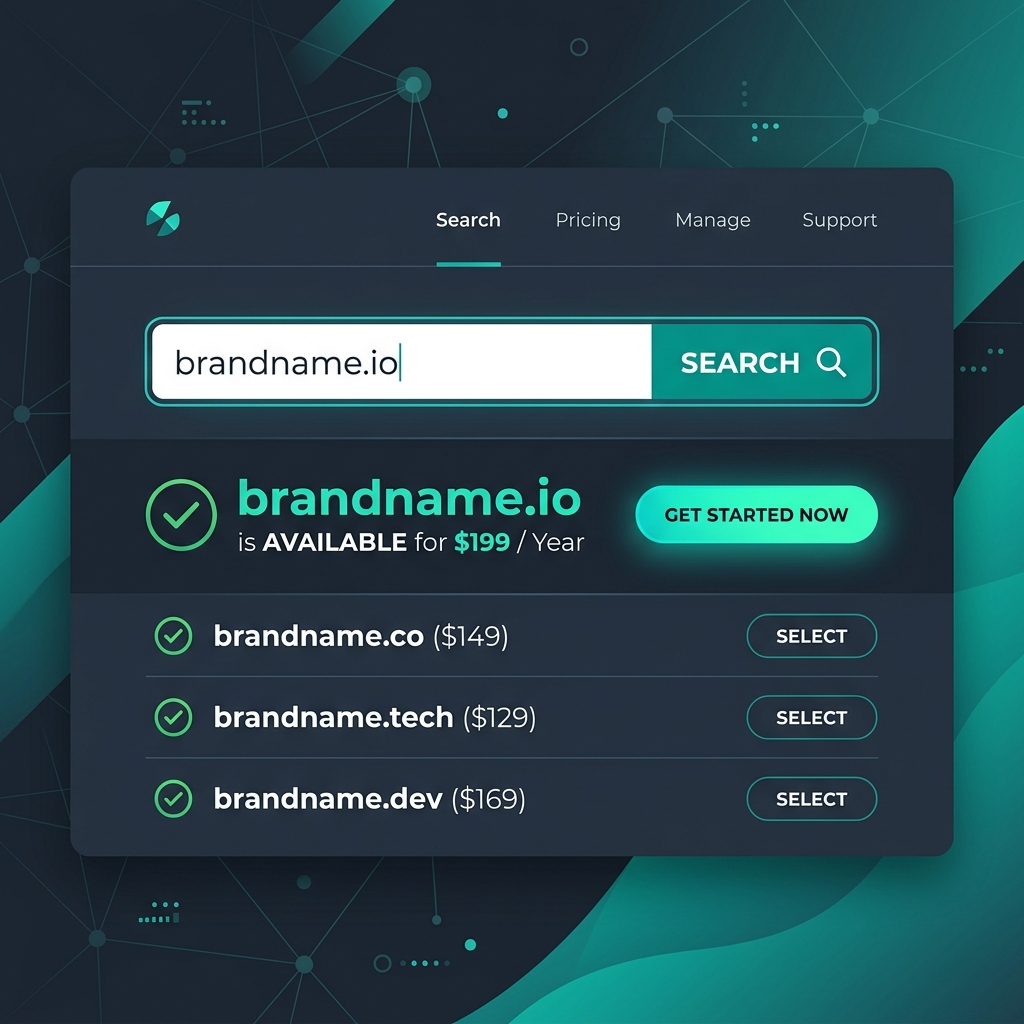
Here is a sample of what the 199.domains flat-rate catalog looks like right now:
The Hidden Cost Nobody Talks About: Momentum
There is one cost that never appears in any fee schedule: the momentum you lose while you are waiting.
In a drop auction, you might spend two weeks monitoring bids, lose on your first three choices, and eventually win something on your fourth attempt. In a broker negotiation, six weeks can pass between first contact and signed transfer. In both cases, your brand identity is on hold. You cannot print business cards, set up email, apply to accelerators, or launch a Product Hunt page without a name.
For SaaS founders and indie builders especially, this carries a real price. If you read our psychology of domain naming, you will know that processing fluency — the ease with which a brand name sticks — is just as important to your own team's momentum as it is to customers. Founders who are still calling their project "the app" six weeks into development are building on sand.
The fastest route to a real name is not always the cheapest in isolation. But when you include the total cost — financial, temporal, and psychological — a $199 flat-rate domain is frequently the most economical decision a founder can make.
A Simple Decision Framework
Before committing to any acquisition channel, answer three questions:
-
Do you need a specific registered name, or do you need a great name? If a specific name is non-negotiable, you are in broker or direct-negotiation territory. If you need a great name from a wide field of options, flat-rate and auctions both work.
-
What is your realistic all-in budget, including time? Add $50/hour for your own time to any "cheap" option. A four-hour auction research session at your effective hourly rate may already exceed $199.
-
When do you need to launch? If your timeline is weeks, a flat-rate marketplace is the only channel that guarantees delivery. If months, auctions and brokers are viable.
If the answer to questions one and two pushes you toward a direct acquisition, our transfer guide — The Complete Domain Transfer Guide: EPP Codes, Locks, and 72-Hour Timelines — walks through every step of what happens after you close a deal on any channel, including how to protect yourself through escrow and ICANN lock rules.
The domain market is not designed to favor buyers. Understanding the full cost structure is how you stay in control of it.