In a decade of brokering premium domains, the calls I dreaded most came from fintech founders. Not because they were difficult — they were usually the most prepared buyers I dealt with — but because they wanted the hardest, most picked-over words in the entire market. Everyone building in financial tech is reaching for the same small vocabulary of trust: secure, vault, ledger, pay, capital, assure, guard, trust itself. Those words command the highest aftermarket prices of any category, and the founders who needed them most were usually the ones with the least runway to spend.
Here's what a decade on the sell side taught me that the naming-agency blog posts won't: in fintech, the domain is not branding garnish. It is the first trust signal a customer or a regulator ever receives — judged in milliseconds, before anyone reads a single line of your copy. And trust, every study agrees, is fintech's number-one conversion factor. Get the name wrong and you're paying a tax on every sign-up, every compliance review, and eventually a forced rebrand. Get it right and the name does quiet, compounding work for years.
This is the guide I wish every fintech founder had before they opened a "Make an Offer" form. Every domain I feature here is a flat $199.
Why does a fintech domain matter more than a normal startup's?
Every founder is told their name matters. For fintech it's categorically more true, for one reason: you are asking strangers to trust you with their money. A productivity app that looks slightly off loses a curious browser. A fintech that looks slightly off loses someone who was about to link a bank account — and that hesitation is fatal at the exact moment of conversion.
That trust judgment happens before conscious thought. Cognitive scientists call it processing fluency: the easier a name is to read, say, and place, the more trustworthy and competent it feels. A name that's hard to spell, lands on an unfamiliar extension, or carries a whiff of "too good to be true" creates a tiny flicker of doubt — and in finance, doubt is the whole ballgame. (We unpack the science of why certain names feel trustworthy in the psychology of startup domain names.)
There's a second audience most naming guides forget: regulators, banking partners, and compliance teams. Your name will end up on a money-transmitter application, a bank-partnership agreement, a card-network filing. A name that reads as a serious financial entity sails through those reviews. A cute, misspelled, or overclaiming name invites scrutiny — and in some cases, as we'll see, a cease-and-desist.
What naming pattern sells fastest in fintech?
The aftermarket tells you exactly which fintech names are most valuable, because those are the ones that sell fastest and command the highest prices. According to documented 2026 sale-pattern data from PowerDomaining's analysis of the patterns that sell quickest, the single most expensive pattern on the market is a "Trust/Security Root + Tech Ending," which moves at roughly $4,000 to $25,000. That's not a coincidence — it's every fintech founder bidding for the same shelf.
The winning fintech naming patterns, in the order I'd reach for them:
1. Trust/security root + clean ending
A word connoting safety, stability, or clarity — vault, ledger, secure, assure, guard, anchor, harbor — paired with a short, modern ending. This is the highest-converting pattern in finance and, predictably, the priciest on brokers. The trick is to find an adjacent or invented variant (an assure-flavored brandable like zure.co) that carries the connotation without the bidding war.
2. Clear functional + warm modifier
The PayPal model: a literal function (pay) softened with a human, friendly element (pal). It signals exactly what you do while feeling approachable rather than institutional. Wise (formerly TransferWise) is the same instinct, distilled to a single confident word.
3. One clean invented word
Monzo, Chime, Stripe, Plaid, Brex. None mean anything in the dictionary, and that's the point — they're short, ownable, trademark-friendly, and free of the regulatory baggage that comes with literal finance words. Invented one-word names are the strongest long-term brand play, which is exactly why we wrote a whole guide on one-word domains for startups.
4. Two clean words under 12 characters
Sub-12-character two-word names are among the fastest-selling patterns overall, and they let you combine a trust root with a category hint (think NextCapital, OpenLedger styles) while staying spellable. Alliteration and rhythm help recall.
Broker's note: Avoid the "creative misspelling" trap that plagues fintech — swapping c for k, dropping vowels, or stacking -ly/-ify onto a finance word. It reads as startup-desperate in a category where customers are scanning for reasons not to trust you. A clean, real word almost always beats a mangled one.
Which TLD do fintech customers actually trust?
This is where fintech founders overthink and underspend. The data is unusually clear. Independent consumer research from Growth Badger's top-level-domain trust study measured how much people trust each extension on a 1–5 scale and how they behave when recalling a URL:
| TLD | Trust score (1–5) | Best fit for fintech |
|---|---|---|
| .com | 3.5 (highest) | Consumer finance, payments, anything mass-market |
| .co | 3.4 (close second) | Modern fintech brands; a genuine category favorite |
| .org / .us | 3.3 | Co-ops, nonprofits, gov-adjacent finance |
| .io | ~3.0 | Developer-facing fintech infra and APIs |
| .biz | 2.9 (lowest measured) | Avoid for consumer trust |
Two findings should anchor your decision. First, .com still wins on raw trust, and the gap matters more in finance than anywhere else. Second — and this is the one founders ignore — the study found people are 3.8x more likely to assume a brand ends in .com than any other extension when they try to recall it from memory. In fintech, that "assume .com" reflex means type-in and branded-search traffic will silently flow to whoever owns the matching .com, even if you launched on .co or .io.
The practical playbook:
- Consumer-facing fintech: get the
.comif you possibly can. It's the default trust currency for people moving their own money. - Developer/infra fintech (APIs, ledgers, embedded finance): a
.ioor even.devreads as credible to a technical buyer, and forced-HTTPS extensions like.appadd a literal security signal. - Either way: if you can't launch on the
.com, secure it defensively. Buying the matching.comearly for $199 is insurance against the leak that forces a rebrand later — a trap we documented in the 7 domain-name warning signs you need to rebrand.
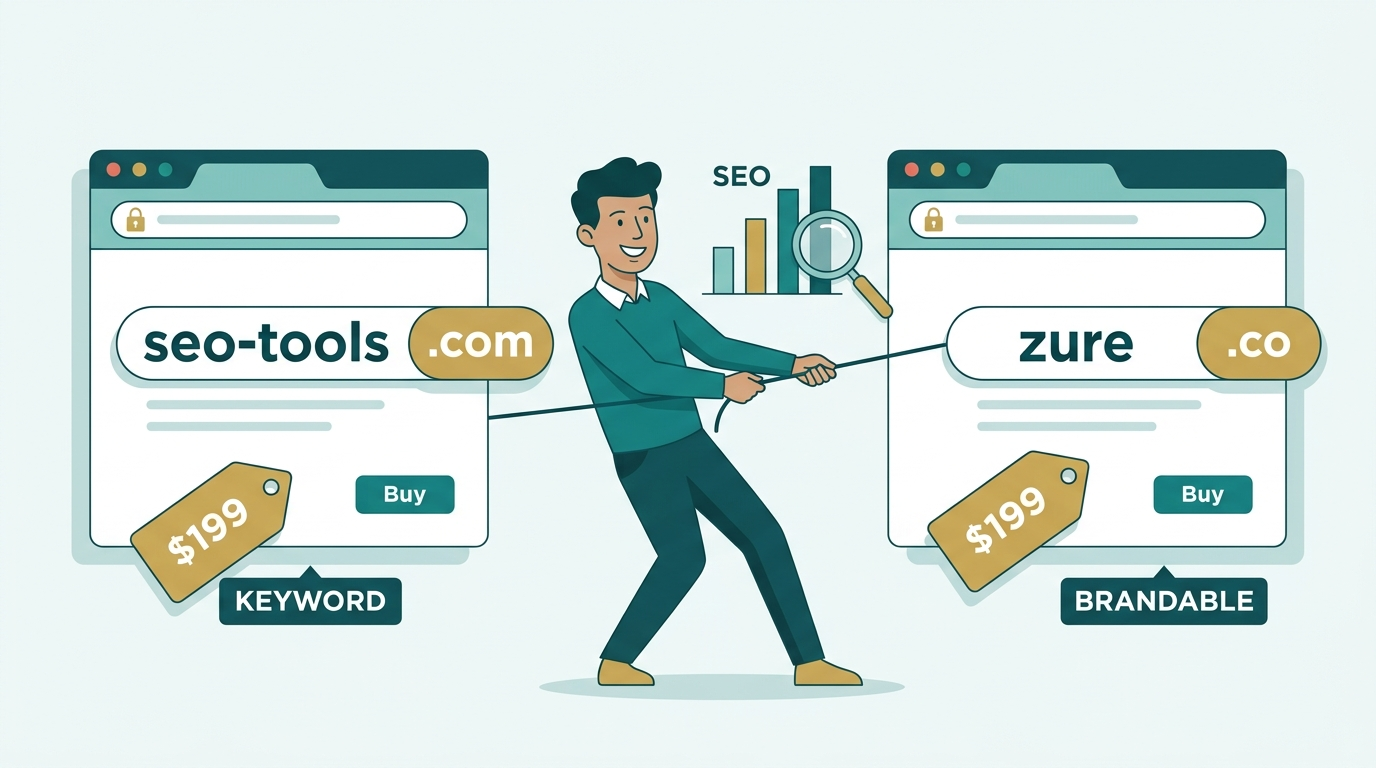
For a deeper, audience-by-audience breakdown of how each extension lands, see our comparison of keyword vs. brandable domains for SEO and the SaaS-focused best domain names for SaaS startups in 2026.
The restricted-word trap: when a domain gets a regulator's letter
This is the section the naming-agency posts skip, and it's the one that has cost fintech founders the most. In the financial sector, certain words in your name are legally restricted. Depending on jurisdiction, you generally cannot call yourself a "bank," do "banking," offer "insurance," or deal in "securities" unless you hold the corresponding charter or license. Regulators — and in the U.S. the Financial Crimes Enforcement Network (FinCEN) and the federal banking agencies — treat an unlicensed entity implying it's a depository institution as a serious problem, not a branding quirk.
The failure mode is brutal: you build a brand and a domain around [something]bank.com, gain traction, and then receive a letter informing you that you must stop using the term. Now you're forced into a rebrand and a domain migration at the worst possible time, with regulatory pressure on the clock.
The safe approach is to evoke trust without claiming a regulated category:
- ✅ Safe trust roots: secure, vault, ledger, assure, guard, anchor, harbor, mint, capital (capital is generally fine), pay, fund, wallet
- ⚠️ Handle with care / often restricted: bank, banking, insurance, insurer, securities, trust (as in "trust company"), credit union
- ❌ Avoid implying deposit insurance or a charter you don't hold
When in doubt, the rule I gave every fintech client: pick a name that could appear on a regulatory filing without raising a single eyebrow — because one day it will.
The 15-minute trademark prescreen for fintech
Finance is one of the most trademark-dense industries on earth, which makes name collisions both more likely and more expensive. Before you fall in love with a name — let alone buy the domain — run a fast clearance pass:
- Search the exact term on the USPTO's official trademark search system. Look for live marks in the financial-services classes (most relevant: Class 36, financial and monetary services). A live, confusingly similar mark in Class 36 is a hard stop.
- Check for near-misses, not just exact matches. Trademark law turns on "likelihood of confusion," so a name that sounds or looks like an established fintech in the same space is a risk even if it's spelled differently.
- Do a plain web and app-store search. If a funded competitor already uses the name informally, you'll be fighting uphill regardless of registration status.
- Confirm the domain's own history is clean. A previously-used domain can carry prior spam, phishing, or scam associations — radioactive in finance. (This is exactly the vetting a curated marketplace does before listing.)
This isn't legal advice and it doesn't replace a trademark attorney before you commit serious capital — but fifteen minutes here routinely saves a six-figure forced rebrand later.
What does a credible fintech domain actually cost?
Here's the uncomfortable math. The trust/security naming pattern fintech founders want is, by the aftermarket's own data, the single most expensive category on the market — $4,000 to $25,000 on brokers — precisely because every fintech is competing for the same trust words. And that price has nothing to do with the name's intrinsic value; it's the seller's anchor plus a 15–25% commission baked in.
| Acquisition route | Typical fintech-name cost | Trust/trademark vetting | Time to own |
|---|---|---|---|
| Broker / make-an-offer | $4,000–$25,000+ | Your responsibility | 2–8 weeks of negotiation |
| Expired auction | $50–$2,000 + fees | Your responsibility | Days–weeks of hunting |
| New-register alt-TLD | $10–$200 | N/A (but availability is thin) | Instant |
| Flat-rate curated ($199) | $199 flat | Done before listing | Instant checkout, transfer in 72h |
The flat-rate model exists precisely to break the anchoring game. On a curated marketplace like 199.domains, every name is one fixed price — $199 — and every listing has already been screened for clean history and trademark conflicts before it ever appears. For the full breakdown of why aftermarket prices balloon and how to acquire a premium name affordably, read how to get a premium domain for under $500.
A fintech naming checklist before you buy
Run every candidate name through this before you check out:
- Radio test: can a stranger spell it correctly after hearing it once? (No hyphens, no numbers, no creative misspellings.)
- Trust read: does the root connote security, clarity, or stability without overclaiming?
- Regulator-safe: does it avoid restricted words (bank, insurance, securities) you aren't licensed to use?
- TLD fit:
.comfor consumer finance,.coas the close runner-up,.io/.appfor developer/infra fintech — plus the defensive.comif you launch elsewhere. - Trademark clear: no live confusingly-similar mark in Class 36 on USPTO.
- Clean history: no prior spam, phishing, or scam use on the domain.
- Room to grow: the name doesn't box you into one product if you expand from, say, payments into lending.
The bottom line
In fintech, the name is the first promise you make about how seriously you'll handle someone's money — and it's read, by customers and regulators alike, in the time it takes to glance at a browser bar. The patterns that win are the boring-sounding ones: a clean trust or security root, a recognized TLD, a name spellable on the first try, and zero regulatory landmines. The patterns that lose are the clever ones.
The aftermarket will happily sell you those trust words for $4,000 to $25,000. You don't have to play that game. A vetted, trademark-screened, regulator-safe fintech name is a flat $199 on our curated catalog of brandable domains — every listing checked for clean history and trademark conflicts, every one ready to transfer to your registrar within 72 hours. Pick the name a compliance officer would nod at and a customer would trust on sight, and you've bought the cheapest growth lever in finance.