Every founder who's ever called me about a rebrand opens with the same nervous sentence: "This is probably a dumb question, but…" It's never a dumb question. By the time someone is willing to consider changing the name they've poured two years into, the name is usually already costing them real money — they just can't always see where the leak is.
I spent a decade brokering premium domains, and a surprising share of my biggest deals were forced rebrands: companies buying back the exact-match .com they should have secured on day one, paying five and six figures for a name they could have locked down for the price of a dinner. The pattern was so consistent it became predictable. The warning signs show up long before the crisis.
So this is the guide I wish those founders had read earlier: the seven domain-name warning signs that mean it's time to rebrand, an honest cost framework by stage, the cheap fix that prevents the whole mess, and — if you do have to move — a Google-documented migration checklist so you don't torch your SEO on the way out. Every domain I feature here is a flat $199.
Is It Actually Time to Rebrand, or Are You Just Bored?
Let's clear the most expensive mistake first: rebranding for the wrong reason. A rebrand is, in the only currency that matters early on, focus — it steals cycles from shipping and selling. If you're pre-product-market-fit, do not touch the name. Nobody has heard it yet, so changing it changes nothing except your to-do list.
The signs worth acting on are structural, legal, or repeated and external — measurable leaks, not internal moods. "We've grown tired of the logo" is not a reason. "Half our inbound traffic is landing on a competitor's exact-match domain" is. The seven signs below are the ones I've watched escalate from annoyance to emergency. If two or more describe you, it's time to take the decision seriously.
The 7 Domain Name Warning Signs You Need to Rebrand
1. Your traffic is leaking to the exact-match .com you don't own
This is the number-one forced-rebrand trigger I've seen, full stop. You launched on yourbrand.io or getyourbrand.com because the clean yourbrand.com was taken or looked expensive. Now you've built brand recognition — and every time someone hears your name and types yourbrand.com into the address bar, they land on a parked page, a competitor, or worse. That's type-in traffic and branded search, two of the strongest trust signals a company can earn, flowing straight to someone else's domain.
You can't 301-redirect a domain you don't own. The only fixes are buying it back (expensive, and the owner now knows you need it) or rebranding entirely. Both cost far more than the $199 it would have taken to secure the matching name early. If you're weighing a .io-to-.com move specifically, our .app vs .dev vs .io comparison breaks down when the upgrade is worth it.
2. You spell your name on every single phone call
Watch yourself on your next three sales or support calls. If you're saying "that's J-A-X-O-N, no E" every time, your name has a spelling-friction tax. Each spell-out is a tiny moment of doubt injected into a conversation where you're trying to build confidence. At scale — every podcast mention, every conference intro, every voicemail — that friction compounds into lost recall and lost word-of-mouth. A name that survives the radio test (can a stranger spell it after hearing it once?) is worth real money. One that fails it leaks customers silently.
3. A trademark or cease-and-desist letter just landed
Nothing forces a rebrand faster than legal pressure. If a more established company holds a registered trademark in your class and your name is "confusingly similar," you can lose a UDRP dispute and the domain with it — or simply burn months of runway in legal back-and-forth. This is the one warning sign where the answer is almost always "rebrand now, fully, and clear the new name first." Before you commit to any new name, run it through the free USPTO trademark search — fifteen minutes there can save a second forced rebrand down the line.
4. You're suffering "GetX / TryX" prefix fatigue
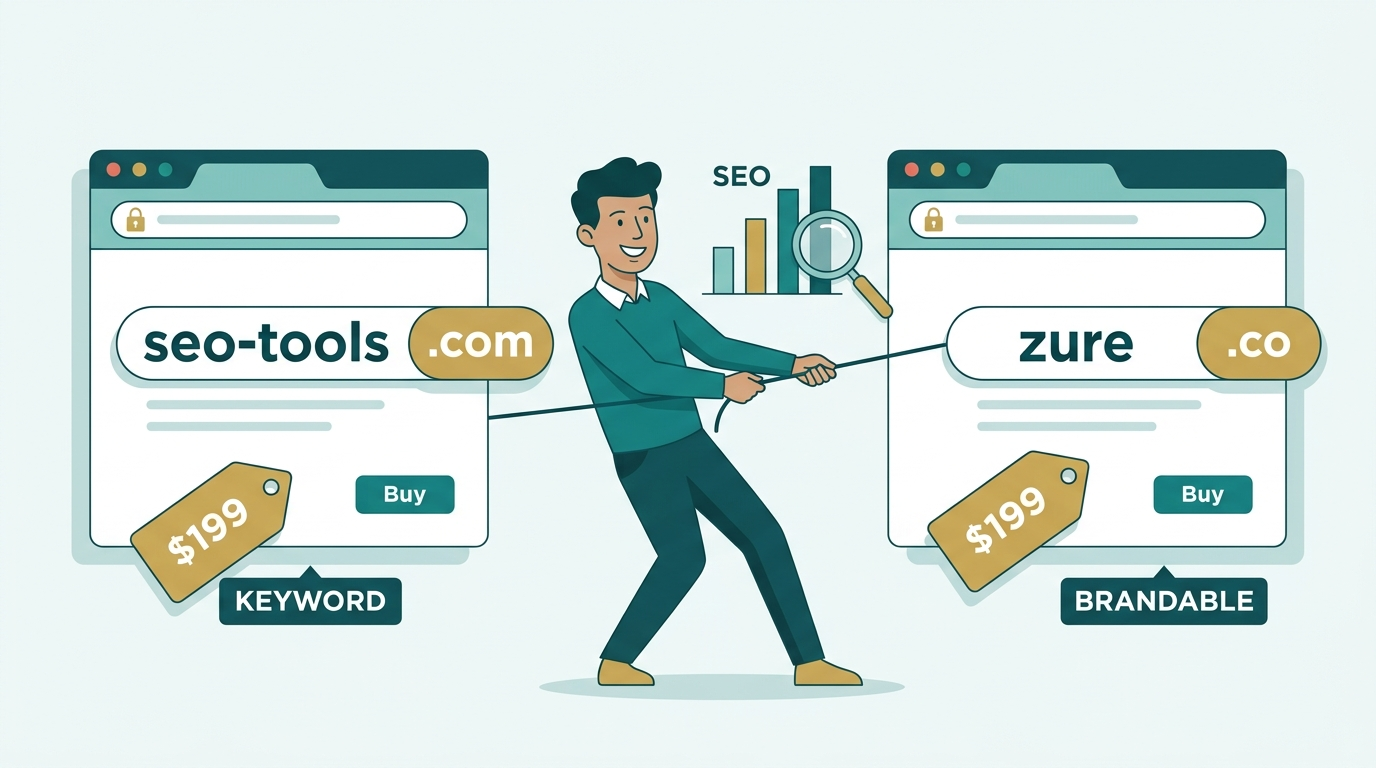
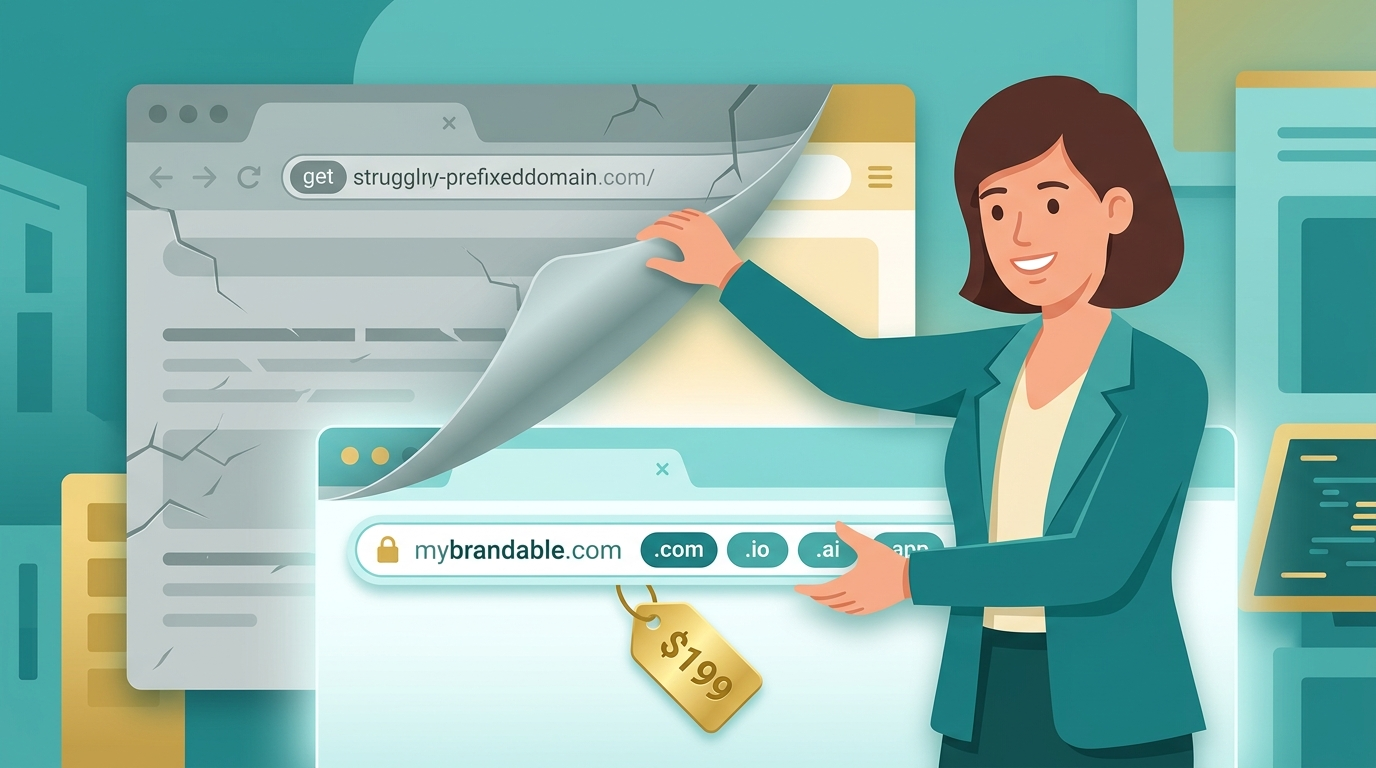
getnotion.com, tryslack.com, usepanda.com — the prefix workaround is a tell that the real name was already taken when you launched. It works at first. But the prefix becomes a permanent asterisk: people drop it in conversation, type the bare name, and land somewhere that isn't you. As you grow, the prefix reads as "we couldn't get the real domain," which quietly undercuts the credibility you're working to build. Many of the cleanest exits from prefix fatigue are a short, prefix-free brandable name — exactly the kind of name we cover in the psychology of startup domain names.
5. The name means something unfortunate in another market
The moment you go international — or even start selling to a diaspora audience at home — pronunciation and meaning traps surface. A name that's clean in English can be unpronounceable, unspellable, or unintentionally funny in Spanish, German, or Mandarin. If expansion is on your roadmap and your name keeps generating confused looks in a new market, that's a structural signal, not a cosmetic one. Better to rebrand at 10,000 users than at 10 million.
6. Investors and advisors keep flinching at the name
Founders discount this one, and they shouldn't. When experienced operators repeatedly react to your name — "interesting choice," a pause, a misread on the deck — they're surfacing a signal their pattern-matching brains caught before they could articulate it. One person's opinion is noise. A consistent flinch from people who've seen hundreds of companies is data. If your name keeps reading as "early-stage" or "side-project" to the people writing checks, it may be capping how seriously buyers and partners take you.
7. Your support and billing email is landing in the wrong inbox
This is the quiet operational nightmare. If you're on getyourbrand.com but a customer emails support@yourbrand.com, that email goes to whoever owns the bare domain — not you. Password resets, billing disputes, and refund requests vanish into someone else's mailbox, and you never even know the customer reached out. It's a deliverability and trust problem hiding inside a domain problem, and it's invisible until a frustrated customer finally reaches you through another channel to ask why you ignored them.
What Does a Startup Rebrand Actually Cost?
Here's the uncomfortable truth that the "12 signs it's time to rebrand" listicles skip: the cost of a rebrand isn't fixed — it scales brutally with how long you wait. The same name change that's nearly free pre-launch becomes a six-figure project once you've built SEO equity, paid campaigns, printed materials, app-store listings, and partner integrations on top of the old name.
| Stage | What a rebrand touches | Typical cost | The hard part |
|---|---|---|---|
| Pre-PMF / idea | A domain, a logo, a landing page | ~$199–$1,000 | Nothing — almost free if you own the new name |
| Seed / early users | Domain, design, basic legal clearance, light migration | $5,000–$25,000 | Trademark check + telling your first users |
| Series A / live SEO | 301 migration, paid-campaign assets, sales collateral, integrations | $25,000–$150,000+ | Preserving organic traffic and brand equity |
| Scale / established | All of the above + buying back the exact-match domain | Six to seven figures | The domain owner now has all the leverage |
That last row is where my old brokerage made its money. Tesla reportedly paid around $11 million to acquire tesla.com years after the company was founded — a name they could have, in principle, secured for a registration fee at the start. The economics are merciless: the more successful your brand, the more the domain you skipped is worth, and the more a speculator will charge to give it back.
The takeaway isn't "never rebrand." It's "rebrand early if you must, and do everything you can to never be forced into it late." For why premium names cost what they do — and why a forced buyback runs five figures — see how to get a premium domain for under $500.
The Cheapest Rebrand Is the One You Prevent
Almost every forced rebrand I brokered traces back to a single skipped decision: the founder launched without securing the domain that matched their ambition. They grabbed the available workaround — the prefix, the alt-TLD, the misspelling — and moved on, because the "real" name looked expensive or felt premature.
The fix is to treat your domain as launch infrastructure, not a nice-to-have:
- Secure the exact-match name that matches your brand, not just your MVP. If there's a clean
.com,.co, or.aithat is your brand, lock it down before you build equity on a workaround. - Run the radio test and the trademark test before you commit. Can a stranger spell it after hearing it once? Is the class clear on USPTO? Both checks take minutes and prevent warning signs #2 and #3.
- Buy the obvious defensive variant if type-in leakage (sign #1) is a realistic risk for your category.
On a flat-rate marketplace, this whole insurance policy is a single $199 checkout instead of a future five-figure negotiation. The math only ever gets worse with time — that's the entire reason flat-rate pricing exists, and why we wrote the flat-rate vs. auction domains breakdown. A clean, brandable, trademark-clear name bought early is the cheapest rebrand insurance on the market.
How to Rebrand Without Destroying Your SEO: The 301 Migration Checklist
If you do decide to move, the migration is where startups either preserve their hard-won traffic or torch it. The good news, straight from Google: a clean domain move does not have to cost you your rankings. Here's the checklist I give founders, grounded in Google's official site-move documentation.
- Map every old URL to its new equivalent — one to one. The single biggest mistake is redirecting your entire old site to the new homepage. Each page needs to point to its real counterpart so its accumulated authority transfers.
- Use server-side permanent (301) redirects. Google recommends HTTP permanent redirects specifically, and confirms that 301 redirects pass ranking signals to the destination URL. Crucially, "301 and other permanent redirects don't cause a loss in PageRank."
- Submit a Change of Address in Google Search Console. Verify both the old and new properties, then use the Change of Address tool so Google processes the move faster. (You can skip this only for HTTP-to-HTTPS moves on the same domain.)
- Keep the old domain and redirects live for at least a year. Google advises maintaining redirects "for as long as possible, generally at least 1 year" — and most practitioners keep the old domain registered far longer to protect inbound links and email.
- Update your highest-authority backlinks manually. You can't change every link pointing at you, but you can email the handful of high-value sites and update your own profiles, social bios, and directory listings to the new domain.
- Expect — and don't panic over — a temporary dip. Google states plainly that "the visibility of your content in Search may fluctuate temporarily during the move… a site's rankings will settle down over time." Resist the urge to "fix" things mid-fluctuation.
- Migrate email and reset SPF/DKIM/DMARC on the new domain. Don't let warning sign #7 follow you to the new name — stand up authenticated email on the new domain before you cut over.
Done this way, a rebrand is a managed transition, not a cliff. The horror stories you read about — 40–60% traffic collapses — come from skipped redirect maps and homepage-redirect shortcuts, not from the act of moving itself.
A Quick Self-Diagnostic: Should You Rebrand?
| If this is true… | …then | Why |
|---|---|---|
| Traffic/email leaks to a domain you don't own | Rebrand or buy it back | Structural leak — it won't fix itself |
| You got a trademark / cease-and-desist letter | Rebrand now, clear the new name first | Legal risk to the domain itself |
| You spell the name on every call | Strongly consider it | Compounding recall and word-of-mouth tax |
| Stuck on a Get/Try/Use prefix | Plan the upgrade | Permanent credibility asterisk |
| The name misfires in a target market | Rebrand before you scale there | Cheaper at 10K users than 10M |
| You're just bored of the logo | Don't | Not a leak — it's a mood |
The Bottom Line
A startup rebrand is rarely about taste — it's almost always about a domain quietly costing you growth: traffic bleeding to a name you don't own, friction on every call, a legal letter, or a prefix that whispers "we couldn't get the real one." The seven signs above are the ones that escalate, and the earlier you act, the cheaper the fix.
But the best rebrand is the one you never have to do. Lock down a clean, trademark-clear, exact-match name before you build a brand on a workaround, and you remove your single biggest future rebrand risk for the price of a $199 checkout. If you've outgrown your current name, browse the curated catalog of brandable domains or the latest exact-match arrivals — every listing vetted for clean history and trademark conflicts, every one a flat $199, ready to transfer within 72 hours. Pick the name you won't have to apologize for in two years, and migrate it the right way.