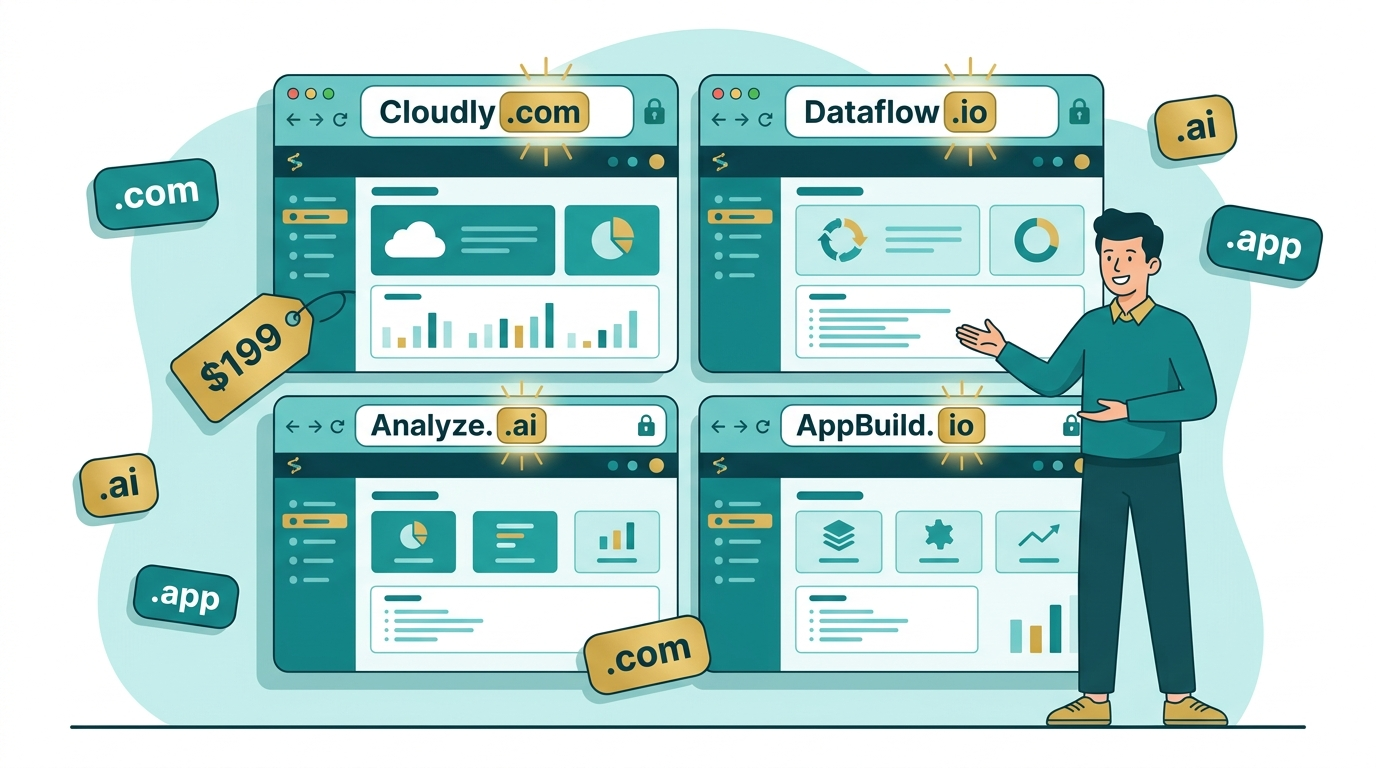
A keyword domain is not just a web address — it is a standing advertisement in every Google search result where it appears. When your domain name is the exact phrase someone searched, you inherit instant recognition, elevated click-through rates, and a head start on topical authority that most coin-a-word brands spend years earning.
This is the complete guide to keyword domain names in 2026: what they are, why they dominate organic search in specific verticals, how to evaluate one, and which keyword domains are available right now for a flat $199 on 199.domains. Whether you are building a niche SaaS tool, a local service site, an AI product, or a content-first brand, this guide will show you exactly when and how to bet on keywords over brand.
What Is a Keyword Domain?
A keyword domain contains one or more words that your customers actively search for. Rather than an invented name like Klarna or Twilio, a keyword domain describes the product or service in plain language — debug.bot, algorithms.dev, collegeloans.net.
The spectrum runs from fully descriptive to keyword-adjacent:
| Type | Example | Description |
|---|---|---|
| Exact-match | backtaxes.org | Domain = precise keyword phrase |
| Category + TLD | algorithms.dev | Keyword amplified by a descriptive extension |
| Partial-match compound | agentbuilderkit.com | Keyword phrase + modifier |
| Geo + keyword | atlantasalons.com | Location + category keyword |
All four carry search intent signals. The further left on the table, the more direct the organic lift — and the more difficult these domains are to acquire on the open aftermarket. On 199.domains, every type is a flat $199.
The Organic Search Advantage: Why Keyword Domains Still Win
Google's 2012 Exact Match Domain (EMD) update did not kill keyword domains — it killed thin keyword domains with no content. Premium keyword domains paired with genuine, substantive content remain among the highest-performing organic assets a business can own. Here is why:
1. Click-Through Rate Lift in SERPs
When your domain name matches the searcher's query, Google bolds the matching words in your search result. Bold text draws visual attention — and attention drives clicks. A site on algorithms.dev ranking for "algorithms for developers" shows bolded domain text in the result, a passive CTA that generic brand names cannot replicate.
Studies by Moz and Backlinko consistently show that domain relevance is among the top five signals searchers use to decide which result to click. A keyword domain makes relevance visible.
2. Topical Authority Signals
Search engines infer category expertise partly from the domain itself. A site about AI debugging tools on debug.bot or algorithms on algorithms.dev sends a persistent topical signal to Google's entity and topic modelling — every crawl, every backlink, every anchor text reference reinforces it. This compounds over time into topical authority: the state where your site is the default answer for a category.
3. Direct and Type-In Traffic
Users who need a specific service often skip Google and guess the URL. A keyword domain captures this type-in traffic as free, direct visits with zero acquisition cost. When someone needs a lesson plan tool, they might type lessonplan.io directly. A brandable name only earns type-in traffic after years of brand building.
4. Backlink Anchor Text
When other sites link to a keyword domain, they naturally use the domain name or a close variant as anchor text — exactly the keyword anchors that SEOs spend money acquiring. Organic editorial anchor text is among the most trusted ranking signals. A keyword domain earns it passively, at scale.
5. Instant User Trust for High-Intent Categories
Users evaluate search results in under 200ms. A domain that matches what they searched communicates specialization and expertise before a single word of content is read. For high-stakes categories — loans, insurance, health, professional services — this first-contact trust signal directly affects conversion.
Immediate Brand Recognition: The Other Half of the Equation
Beyond search, keyword domains deliver what brandable names require years to build: instant category recognition at first contact.
When a potential customer sees bestdiets.org in a health forum, carpetcleaningbirmingham.com in a local Google result, or collegeloans.net in a student resource post, they know in under a second what the site is about. There is no brand equity to build first — the name does the positioning work from day one.
This matters most for:
- Niche tools and SaaS where buyers search by job-to-be-done ("daily planner app", "code snippets", "AI agent builder")
- Local services where geographic + category keywords drive nearly all discovery
- Finance and insurance where high-intent searches dominate customer acquisition
- Content sites and authority blogs where the domain appears in every SERP listing and social share
A keyword domain is a permanent, passive marketing channel embedded in the product's identity.
Featured Keyword Domains
These six domains are featured picks from the keyword catalog — premium names with exceptional SEO positioning available right now at a flat $199:
debug.bot is a standout — the .bot extension creates a natural category pairing with debugging and AI automation tooling, and the name will appear bolded for any "debug bot", "AI debugger", or "debugging assistant" SERP. lessonplan.io targets the exact phrase teachers and curriculum designers search most, while finals.io owns the exam preparation and education-finals category in a single, memorable name. Every one is a flat $199.
Keyword Domains for AI, Developers & Technical Products
AI and developer tools live and die by search discovery. When a developer needs a scraper, an algorithm library, or an AI agent framework, they type the exact words into Google or a package manager search. A keyword domain positions your tool as the default answer to that query.
artificialintelligence.dev is a rare long-keyword domain — it is the full-phrase exact match for one of the highest-volume search terms in tech, on a developer-credible TLD. A content site, course platform, or AI documentation hub on this domain would inherit enormous topical authority from day one. algorithms.dev is equally commanding for computer science education, interview prep, and technical content. agentbuilderkit.com targets the fast-growing AI agent and LLM framework market with a precise keyword compound. These are not invented names — they are the exact words your customers are already searching.
Keyword Domains for SaaS, Productivity & EdTech
SaaS keyword domains are among the most consistently high-performing assets in organic SEO. When a buyer searches "daily planner app", "lesson plan tool", or "reseller platform", the site whose domain contains that keyword earns a persistent SERP advantage that compounds with every new piece of content.
dailyplanner.io sits at the intersection of enormous search volume ("daily planner", "daily planner app", "digital planner") and a polished SaaS TLD — it would rank on target terms almost immediately with a quality product behind it. lessonplan.io and finals.io own two of the most searched terms in K-12 and higher education. resellers.app captures the growing resale economy with a clean keyword compound that will earn natural mentions from commerce and e-commerce content.
Keyword Domains for Finance, Insurance & Lending
Finance and lending keyword domains convert at exceptionally high rates. Users searching for tax help, student loans, or insurance are high-intent buyers — they have a problem and a budget. A domain that matches their search query reduces friction at every stage of the funnel: the click, the landing, the trust assessment.
backtaxes.org is a near-perfect keyword domain for the tax relief and IRS resolution market — "back taxes" is among the highest-CPC keyword phrases in finance, and the .org extension carries implied trust that aligns with a consumer resource or advocacy positioning. collegeloans.net owns the student lending keyword space with a clean exact-match compound. betterinsurance.ca is an exceptional keyword domain for the Canadian insurance comparison market — "better insurance" is a high-intent comparative search phrase, and the .ca extension provides automatic geo-targeting for Canadian organic results.
Keyword Domains for Local Services & Businesses
Local keyword domains are among the most immediately actionable SEO assets available. Google's local search algorithm heavily weights topical relevance — a domain that contains both the service category and the city name sends the strongest possible relevance signal for local pack results.
Geo + category keyword domains are uniquely powerful for local businesses because they match the exact query pattern Google's local algorithm targets: city + service. carpetcleaningbirmingham.com and atlantadeckrepairs.com will appear in local pack results for those exact search phrases with minimal additional SEO effort — the domain does the geo-targeting work at the infrastructure level. cateringservice.us is a national play — the .us TLD is optimised for United States organic results, and "catering service" is a high-volume, high-intent search term. nycbistro.com is a premium local brand name for a New York restaurant — short, memorable, and geo-keyword aligned.
Keyword Domains for Automotive & Consumer Parts
Automotive keyword domains attract some of the most commercially valuable organic traffic on the web. Searches like "ceramic brake pads", "cheap car batteries", and "automotive parts" carry extremely high purchase intent — the user already knows what they want and is ready to buy. A domain that matches this intent reduces every friction point between the search result and the transaction.
ceramicbrakepads.com and cheapcarbatteries.com are near-perfect product keyword domains — both terms are high commercial-intent search queries, both are .com for maximum consumer trust, and both will earn natural review and affiliate links that use the domain name as anchor text. automotiveparts.co is a horizontal marketplace name — it covers the entire auto parts category and will rank across a broad set of component and parts queries. carhelp.xyz is a versatile keyword domain for automotive content, guides, and advisory services.
Keyword Domains for Web Hosting & Cloud Infrastructure
The web hosting market is one of the highest-CPC keyword verticals on the web — "cloud hosting", "enterprise web hosting", and "shared hosting" are searched millions of times per month with significant affiliate and conversion value. A keyword domain in this space inherits topical relevance from its first day indexed.
enterprisewebhosting.com targets enterprise IT buyers — a high-value audience searching specific solution terms rather than browsing categories — while cloudsharedhosting.com covers the high-volume consumer and SMB segment searching for affordable cloud hosting options. Both are exact-match keyword compounds on .com, which means natural backlink anchor text from every review, comparison, and affiliate post that references them.
Keyword Domains for Health, Lifestyle & Content
Health and lifestyle keyword domains are among the most durable content site assets: search volume is evergreen, topical authority compounds over years, and a domain that matches the core health topic earns trust signals from users and editorial links from authority sites.
bestdiets.org is a high-authority content domain — "best diets" and related terms have enormous evergreen search volume, .org carries implicit credibility for health and wellness content, and the name will earn natural links from nutrition, health journalism, and medical reference sites. filmcams.com owns the analogue photography and film camera revival niche — a passionate, growing community with strong organic search behaviour. creatordirectory.com targets the creator economy aggregation and discovery space, a category growing rapidly in both audience size and search volume.
Choosing the Right TLD for a Keyword Domain
TLD selection shapes how a keyword domain ranks, converts, and is perceived. The right TLD amplifies the keyword — choosing wrong undermines it.
| TLD | Best For | Consumer Trust | Geo Signal |
|---|---|---|---|
.com |
Consumers, finance, retail, local | Highest | Global |
.org |
Resources, communities, health, nonprofits | High (trust) | Global |
.net |
Networks, lending, infrastructure | Medium-high | Global |
.dev |
Developer tools, APIs, technical content | High (tech) | Global |
.app |
Applications, mobile tools | High (tech) | Global |
.io |
SaaS, tech platforms, startups | High (tech) | Global |
.bot |
AI automation, chatbots, agents | Emerging | Global |
.co |
Modern alternative to .com | Medium | Global |
.ca |
Canadian businesses | High (CA) | Canada |
.us |
US-focused services | Medium | United States |
.zone |
Communities, hubs, niche platforms | Medium | Global |
The keyword + TLD pairing is the most important decision in keyword domain strategy. algorithms.dev is stronger than algorithms.com for a developer audience precisely because the TLD reinforces the technical context. backtaxes.org carries more implied consumer trust than backtaxes.com would for a resource-first positioning. debug.bot is a natural semantic pairing — the extension tells you the tool category before you read the root word.
For a deeper breakdown, read our guide on domain name psychology and TLD selection.
How Google Treats Keyword Domains in 2026
Google's stance on keyword domains has evolved considerably since the 2012 EMD update.
What changed in 2012: Google reduced ranking boosts for low-quality sites on exact-match domains — sites that ranked solely because the domain matched a query, with no substantive content behind it. This targeted spam, not quality keyword domains.
What remains true in 2026: Keyword domains with quality, substantive content continue to earn:
- Higher average CTR in SERPs from bolded query-matching domain text
- Topical relevance signals for entity and topic modelling
- Natural keyword anchor text from editorial backlinks
- Type-in traffic from users who navigate by category before brand
What matters now: Google's Helpful Content System and its AI-powered ranking models reward expertise, experience, authoritativeness, and trustworthiness (E-E-A-T). A keyword domain provides the search relevance foundation — quality content delivers the E-E-A-T that earns ranking. The two are multiplicative.
The conclusion: a premium keyword domain purchased at $199 today, paired with authoritative, in-depth content, remains one of the highest-ROI organic SEO investments available to a bootstrapped or early-stage product team.
How to Evaluate a Keyword Domain Before Buying
Not every descriptive domain is worth purchasing. Run this checklist before committing:
-
Search volume check. Verify the core keyword in Google Keyword Planner, Ahrefs, or Semrush. Meaningful monthly volume (500+ in your target locale) means the domain has real organic traction potential. Negligible volume means the keyword advantage evaporates.
-
Competition audit. Search the phrase in Google and assess the quality of page-one results. If it is dominated by Wikipedia, government sites, and Fortune 500 companies, a new site will struggle regardless of domain quality. A mix of mid-tier results is the opportunity signal.
-
Trademark check. Keyword domains are harder to trademark because they describe a category. Search the USPTO TESS database for the specific domain combination and consult a trademark attorney for high-stakes launches.
-
Domain history check. Use the Wayback Machine to confirm the domain was not previously used for spam, adult content, or penalised sites. Prior spam penalties are difficult to overcome in Google's trust model.
-
TLD–audience fit. Confirm the extension signals the right category for your audience:
.comfor consumer trust,.dev/.appfor technical credibility,.orgfor community or resource authority,.ca/.usfor geo-targeted services.
Every domain in the 199.domains catalog is pre-screened for clean history and trademark conflicts before listing.
Why 199.domains Is the Best Keyword Domain Marketplace
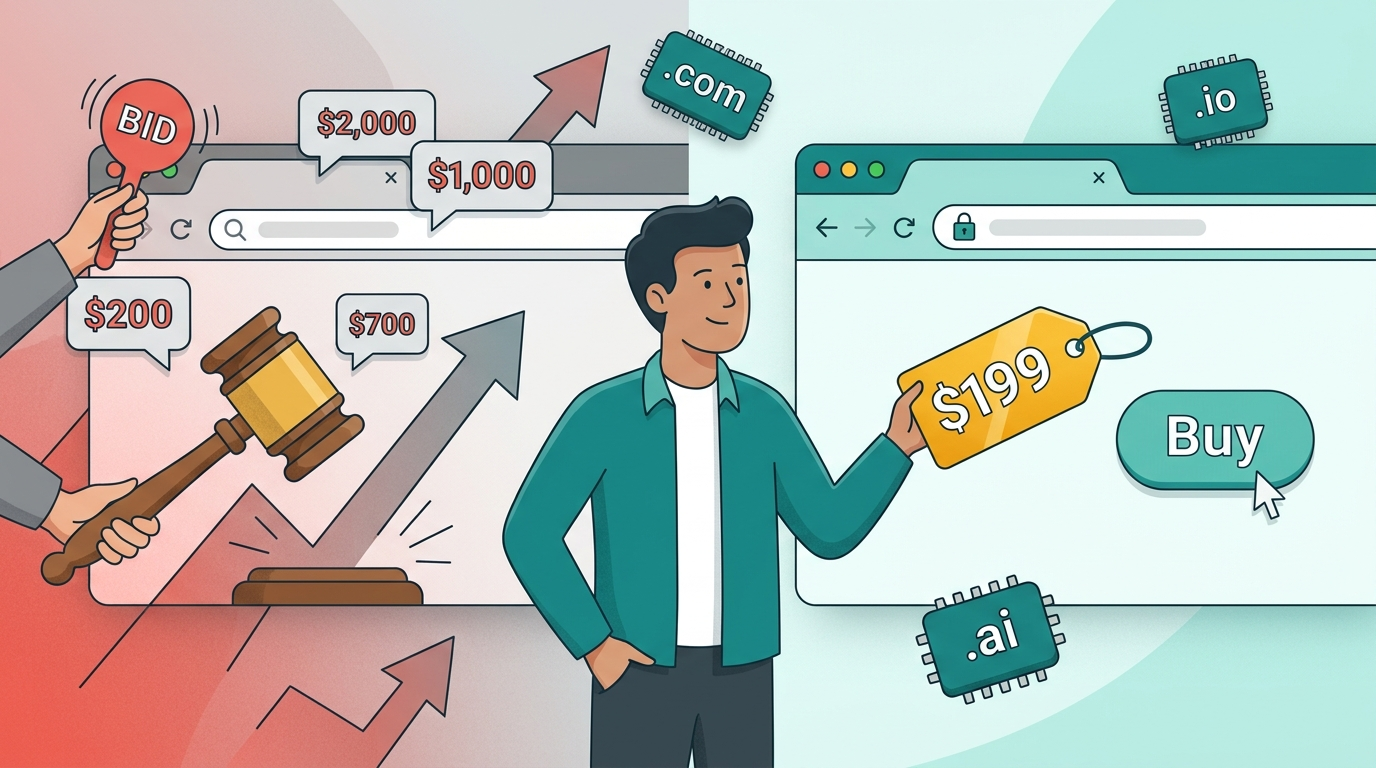
Premium keyword .com names routinely sell for $500 to $50,000+ on aftermarket platforms like Sedo, Afternic, and GoDaddy Auctions. The pricing is driven by broker commissions, auction dynamics, and speculative holding costs. A founder competing against domain investors for a generic keyword .com is at a structural disadvantage.
199.domains rebuilds the model around a single promise: every keyword domain is a flat $199, regardless of category, TLD, or keyword commercial value.
| Feature | Aftermarket Keyword Platforms | 199.domains |
|---|---|---|
| Pricing | $500–$50,000+ | Flat $199 |
| Commission | 10–25% baked in | Zero |
| Negotiation | Required | None |
| Due diligence | Buyer's responsibility | Pre-screened |
| Transfer time | Days to weeks | Initiated within 72 hours |
| Guarantee | Rare | 100% refund if transfer fails |
Checkout runs through Stripe, transfer is initiated within 72 hours, and there is a full money-back guarantee if the transfer cannot be completed. Compare pricing models in our guide to flat-rate vs. auction domain pricing.
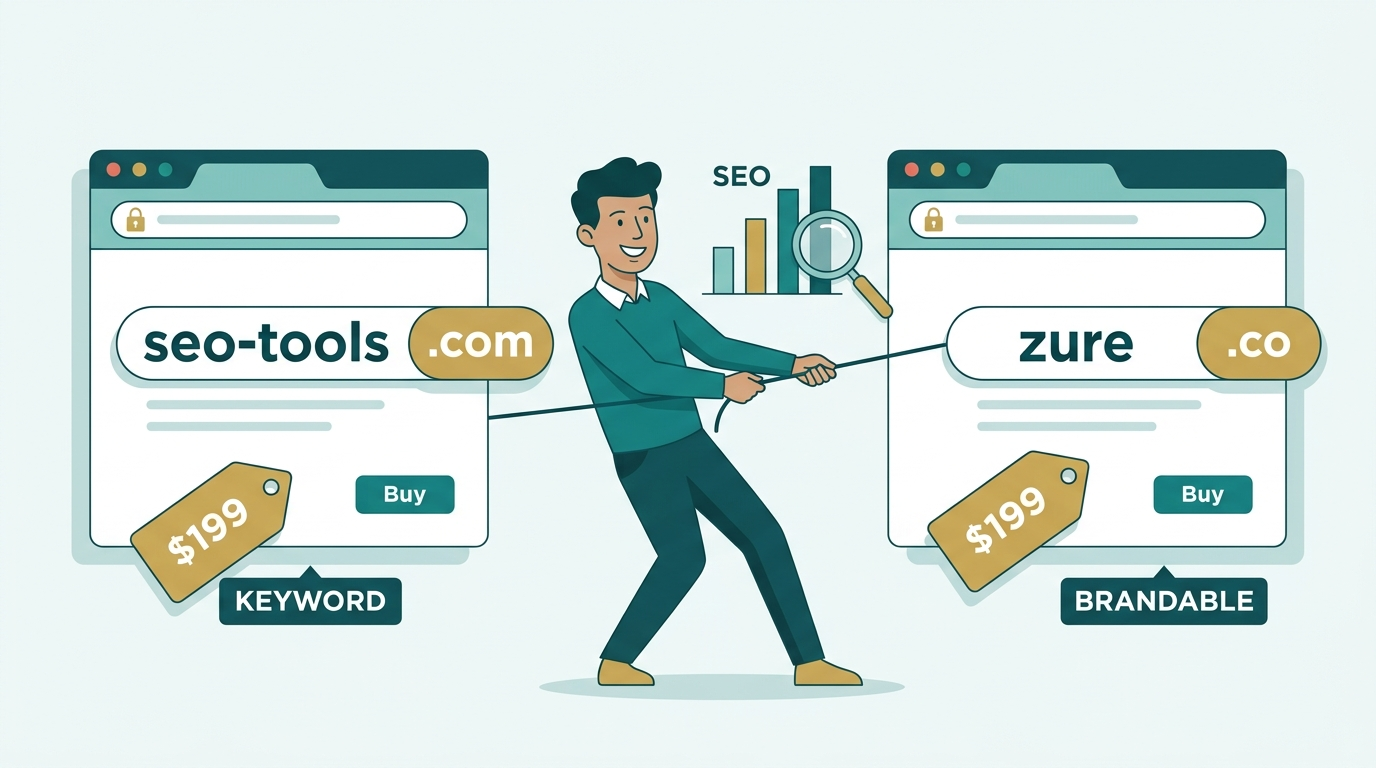
Keyword Domains vs. Brandable Domains: The Decision Framework
Choose a keyword domain when:
- Your primary acquisition channel is organic Google search
- You are building a niche tool, local service, or content site where the category keyword IS the brand
- You are an indie developer or solopreneur with a lean marketing budget who needs passive SEO traction
- You want type-in traffic from category-navigating users from day one
- Your product competes in a high-intent, high-CPC vertical (finance, auto, health, hosting)
Choose a brandable domain when:
- You are building a venture-backed startup with brand-building resources
- You plan to trademark and defend the name globally
- Your product is a horizontal platform where the brand must transcend a single keyword category
- Voice search, podcast mentions, and word-of-mouth will be primary discovery channels
- You are optimising for the long-term brand asset value of the name
The hybrid approach: many successful products use a keyword-adjacent domain — a brandable name with keyword elements — that delivers partial SEO traction while maintaining enough distinctiveness to build a brand. Read the full brandable domains guide for the other side of this decision.
Browse the complete keyword domain catalog, search for your category keyword across the full marketplace, or read our guide on premium domains under $500 before committing. Every domain on the platform is a flat $199 — no negotiation, no broker, no waiting.